Tadelakt and Microcement Guide
With first-hand expertise from Decorbuddi designer Lorraine Sakharet.

Photo Credit: Interior design of tadelakt bathroom by Lorraine Sakharet
Key Takeaways:
This tadelakt and microcement design guide distils one core truth: the right finish depends entirely on how a space is used, not just how it looks.
Both materials deliver the seamless, tile-free aesthetic that defines contemporary luxury interiors, but they achieve it through very different means, and each has a clear natural home within a project. Understanding where they differ is what separates a confident specification from an expensive mistake.
Here is where each material excels:
Choose tadelakt when you want a heritage feel, natural breathability, and the warmth of an artisanal finish, particularly in wet rooms, hammam-style bathrooms, or any space where the handcrafted quality of the surface is part of the design story.
Choose microcement when you need high-traffic durability, faster installation, or are working over an existing substrate without full demolition. Its versatility over existing surfaces makes it the more practical choice for most renovation projects.
Consider the 'middle way': using tadelakt in a wet-room shower enclosure for its natural water resistance, while specifying microcement across the broader floor plan for resilience and visual continuity. Many well-resolved projects use both within a single property, and it is an approach Decorbuddi designer Lorraine Sakharet has used to award-winning effect, as the comparison section below explains.
The single most important step before committing to either material is specialist consultation. Substrate condition, site humidity, underfloor heating, and your installer's specific expertise will all shape which finish is appropriate.
That is precisely where Decorbuddi's network of specialists add real value: matching the right material to the right context, before work begins.
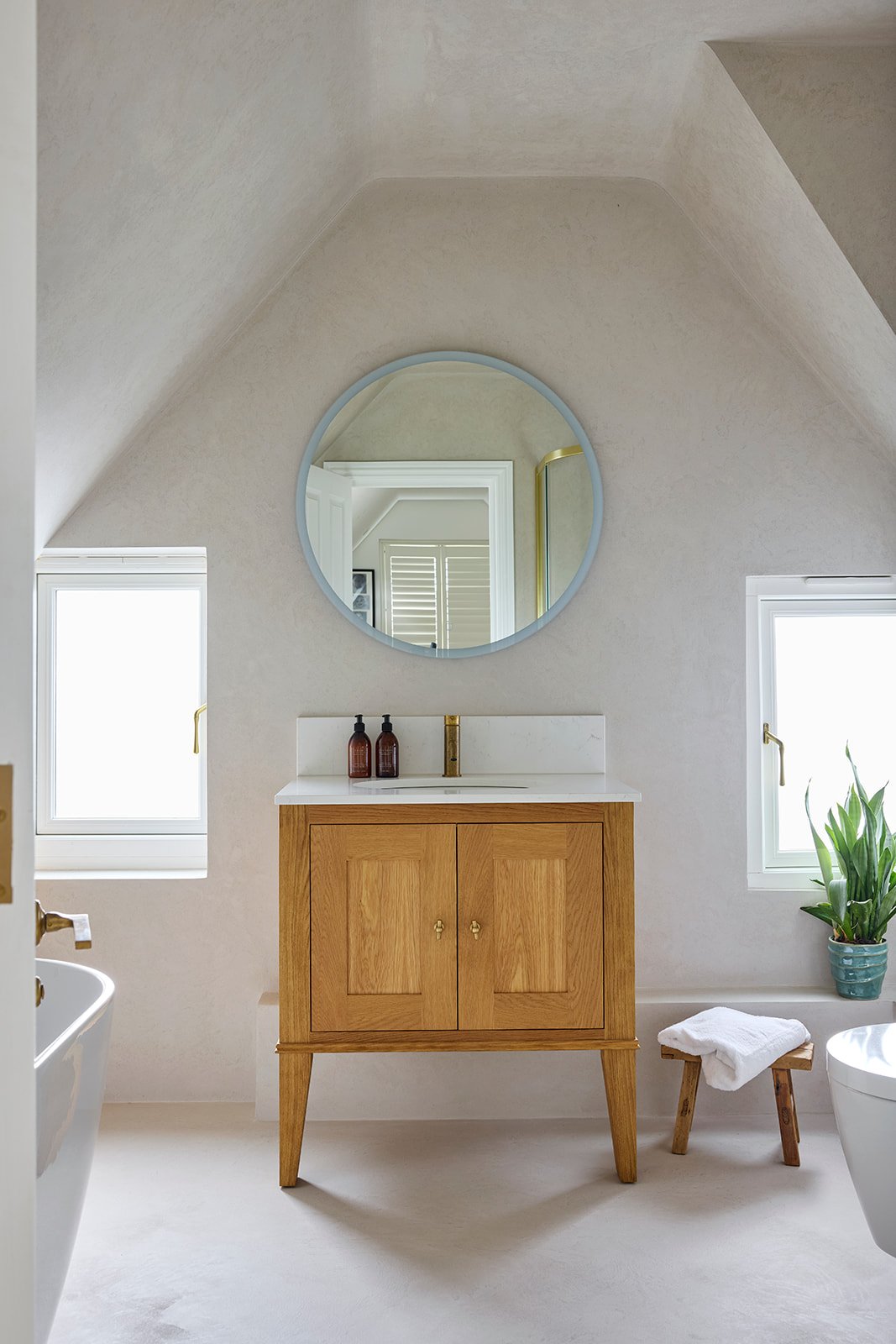

Photo Credit: Interior design from Victorian house renovation by Sophie Wells
The Rise of the Seamless Interior: Why Tadelakt and Microcement Define Modern Luxury
High-end UK renovations are moving away from traditional tiling, and the shift is accelerating.
Where bathroom walls once meant grout lines, textured ceramics, and the inevitable maintenance that follows, homeowners and designers are now finding a better fit in finishes that disappear into the architecture itself.
The appeal is both aesthetic and practical: seamless surfaces are visually larger, calmer, and more considered than their tiled counterparts. When a bathroom wall flows uninterrupted from floor to ceiling, or a kitchen splashback continues into a worktop without a single break, the eye has nowhere to snag.
That visual continuity makes even modest spaces feel generous, a quality that is difficult to achieve with conventional materials.
This is the essence of the monolithic aesthetic that defines so much contemporary and Mediterranean-inspired design right now. Whether it is a pared-back London flat or a sun-washed renovation in the south of France, the look prioritises mass, texture, and flow over pattern and division.
Microcement is a seamless coating with no grout lines for dirt can accumulate, making it one of the most hygienic surfaces available, a practical advantage that sits neatly alongside the visual one.
But the monolithic finish is not a single material. When you dig into tadelakt and microcement for luxury interiors, you quickly encounter a genuine design dilemma: an ancient Moroccan lime plaster on one side, and a cutting-edge polymer-modified cement system on the other.
Both deliver that seamless, sculptural quality. Both reward skilled application. And both carry distinct characteristics that make one a better fit than the other depending on your project.

Photo Credit: Interior design with Microcement floor in Victorian renovation project by Sophie Wells
Defining Terms: Tadelakt and Microcement
Tadelakt and microcement are not the same material, and understanding the difference is the foundation of every smart finish decision you will make from here.
Tadelakt. A traditional Moroccan lime plaster, hand-applied and then polished with smooth stones and treated with olive oil soap, a labour-intensive process that requires up to seven separate stages to complete correctly.
Microcement. A polymer-modified cement coating applied in multiple thin layers, typically just 2 to 3 mm in total depth, that bonds directly to most existing substrates without the need for structural preparation.
In practice, these terms often get used interchangeably in showrooms and on social media, which muddies the decision-making process. Knowing what each material actually is, not just what it looks like, determines whether your finish will perform as expected over years of daily use.
And that brings us neatly to tadelakt itself: a material with a richer history, a more demanding application process, and a character that evolves beautifully over time.

Tadelakt: The Ancient Art of Moroccan Lime Plaster
Tadelakt is one of the few seamless wall finishes for residential renovation that genuinely improves with age, and that makes it unlike almost anything else in a designer's toolkit. Originating in Marrakech's historic hammams, this burnished lime plaster has been applied by hand for centuries. Today, it brings the same warmth and depth to UK wet rooms, feature walls, and curved architectural details.
The material's high alkalinity is its most practical superpower. Because tadelakt sits at a naturally high pH, it is inherently biocidal and fungicidal, resistant to mould and mildew without any synthetic additives. For a bathroom or shower enclosure, that is a significant health advantage over conventional tiling with its network of grout lines.
And then there is the finish itself. Tadelakt is a 'living' surface: it breathes as humidity rises and falls, and it develops a subtle patina over years of use.
The polished surface deepens in character rather than degrading. As Lorraine puts it, "tadelakt, in particular, tends to become richer and more characterful as it ages." This is a material that rewards patience: the longer it is in a home, the better it tends to look.
Where tadelakt excels most is in spaces with architectural ambition. Curved walls, niches, bespoke bath surrounds: these are the details where its hand-applied nature becomes an asset rather than a constraint. Unlike rigid sheet materials, tadelakt wraps continuously around any form, reinforcing the seamless, sculptural quality that defines contemporary luxury interiors. It is also, in Lorraine's words, "perfect for walls and ceilings," which is exactly where she specifies it.
That artisanal character, however, comes with a critical caveat: this is not a material for DIY experimentation.
Correct application requires precise water management, specific burnishing technique, and exact timing during curing.
A misjudgement at any stage can compromise waterproofing entirely. For the results tadelakt promises, a skilled specialist is non-negotiable, something that microcement, with its more engineered consistency, handles quite differently.
Microcement: The Modern Solution
Microcement is a polymer-modified cementitious coating that delivers industrial-grade durability in a layer just 2 to 3 mm thick, making it one of the most technically capable seamless finishes available for both residential and commercial interiors.
Where tadelakt tends to centre on tactile warmth and artisan character, microcement answers a different brief: consistent performance across large areas, high-traffic floors, and projects where installation speed genuinely matters.
Durability you can measure. Microcement's structural credentials are well documented. Its polymer binders bind the mix into a surface that resists impact, abrasion, and moisture penetration in a way that traditional lime plasters simply cannot match.
Microcement achieves a compressive strength of approximately 35 to 40 N/mm², significantly exceeding traditional lime plasters and making it a realistic choice for kitchen floors, commercial reception areas, and anywhere foot traffic is a genuine daily pressure.
Adhesion over existing substrates is arguably microcement's most practical advantage. In practice, it bonds directly to existing ceramic tiles, concrete screed, plasterboard, and even timber, removing the need to strip out and dispose of old finishes. For renovation projects where budgets and timelines are tight, that alone changes the conversation significantly.
Colour and finish options give microcement a contemporary edge that suits modern interiors well.
It accepts a wide pigment range, delivers consistent colour across large, uninterrupted surfaces, and is available in both matte and gloss sealant finishes. Matte reads as more industrial and understated; gloss adds depth and is easier to wipe clean in kitchens and bathrooms.
That contrast between artisanal process and engineered performance is precisely what the next section unpacks: a direct comparison of how tadelakt and microcement stack up across installation, maintenance, cost, and flexibility.

Photo Credit: Interior design of tadelakt bathroom by Lorraine Sakharet
Tadelakt Vs. Microcement
Choosing between bespoke microcement and tadelakt ultimately comes down to four factors: installation time, ongoing maintenance, budget, and how well your building handles movement.
The comparison table below gives you a clear starting point.
| Feature | Tadelakt | Microcement |
|---|---|---|
| Installation time | 5 to 10 days (artisanal stone polishing) | 3 to 5 days (multi coat layering) |
| Maintenance | Regular olive oil soap reapplication | Periodic resealing with commercial sealant |
| Typical cost | Higher, specialist labour intensive | Moderate, faster application reduces cost |
| Crack resistance | Lower, lime plaster is relatively rigid | Higher, polymer content flexes with movement |
| Aesthetic quality | Organic, hand polished warmth | Consistent, industrial smooth finish |
Installation timelines differ significantly. Tadelakt demands that an experienced artisan work the surface by hand with a polishing stone, building depth and waterproofing through physical compression rather than chemistry. Microcement, by contrast, is built up in thin coats, typically three to five layers, that each cure relatively quickly. On a straightforward bathroom project, microcement can be ready for use several days sooner.
Maintenance is where the two materials diverge most sharply in day-to-day life. Tadelakt requires regular treatment with olive oil soap to maintain its waterproof integrity; skip this ritual and the surface can become vulnerable to water ingress over time. Sealed microcement, on the other hand, simply needs a commercial resealer every few years and tolerates standard cleaning products far more readily. Lorraine frames the everyday reality for clients clearly: "microcement is particularly easy to keep clean, especially across a floor, as it can simply be swept and wiped without having to scrub between tiles. Tadelakt is also relatively straightforward to maintain, although it requires a gentler approach and should not be cleaned with harsh or abrasive products."
Crack resistance favours microcement in most UK homes, where seasonal thermal movement and older building stock create stress that lime plaster can struggle to absorb. The polymer binders in microcement give it genuine flexibility, a meaningful practical advantage in period properties.
On cost, both finishes carry a premium over standard tiling precisely because specialist installers are essential for either material. But microcement's faster cure times generally translate into lower overall labour bills.

Photo Credit: Interior design of tadelakt bathroom by Lorraine Sakharet
A real project: pairing both finishes in one bathroom
The clearest way to understand how these materials relate is to see them used together. On one bathroom project, Lorraine specified tadelakt on the walls and microcement across the floor, playing each material to its strength.
"The two materials worked beautifully together because they shared the same quiet, mineral quality, while bringing very different textures to the room," Lorraine says. "The tadelakt had a softness and subtle movement and slight shine to it, with the gentle variation that comes from being applied by hand, while the microcement provided a cleaner, more grounded solid surface underfoot."
The judgement that made it work was in the tones. Rather than trying to match the two finishes exactly, Lorraine kept them warm and closely related.
"That slight contrast made the scheme feel layered and natural, without interrupting the sense of calm," she explains.
She is equally clear about where a pairing like this goes wrong. "Where the two can clash is if their undertones are wrong, or if both finishes are allowed to compete for attention," Lorraine says. "Tadelakt already has a great deal of character, so an overly mottled or highly textured microcement can make the room feel busy. The junction between the two also needs to be very carefully detailed." The finished bathroom went on to receive a Best of Houzz award.
Designer tip: When combining tadelakt and microcement, keep the tones warm and closely related rather than identical, let one material carry the character while the other stays quieter, and detail the junction between them deliberately. That is the difference between a scheme that feels layered and one that feels busy.
Both finishes perform brilliantly in wet areas, and the bathroom is where that choice becomes most consequential. The next section explores exactly how each material holds up in showers, and how to design around niches, benches, and brassware without a single grout line in sight.
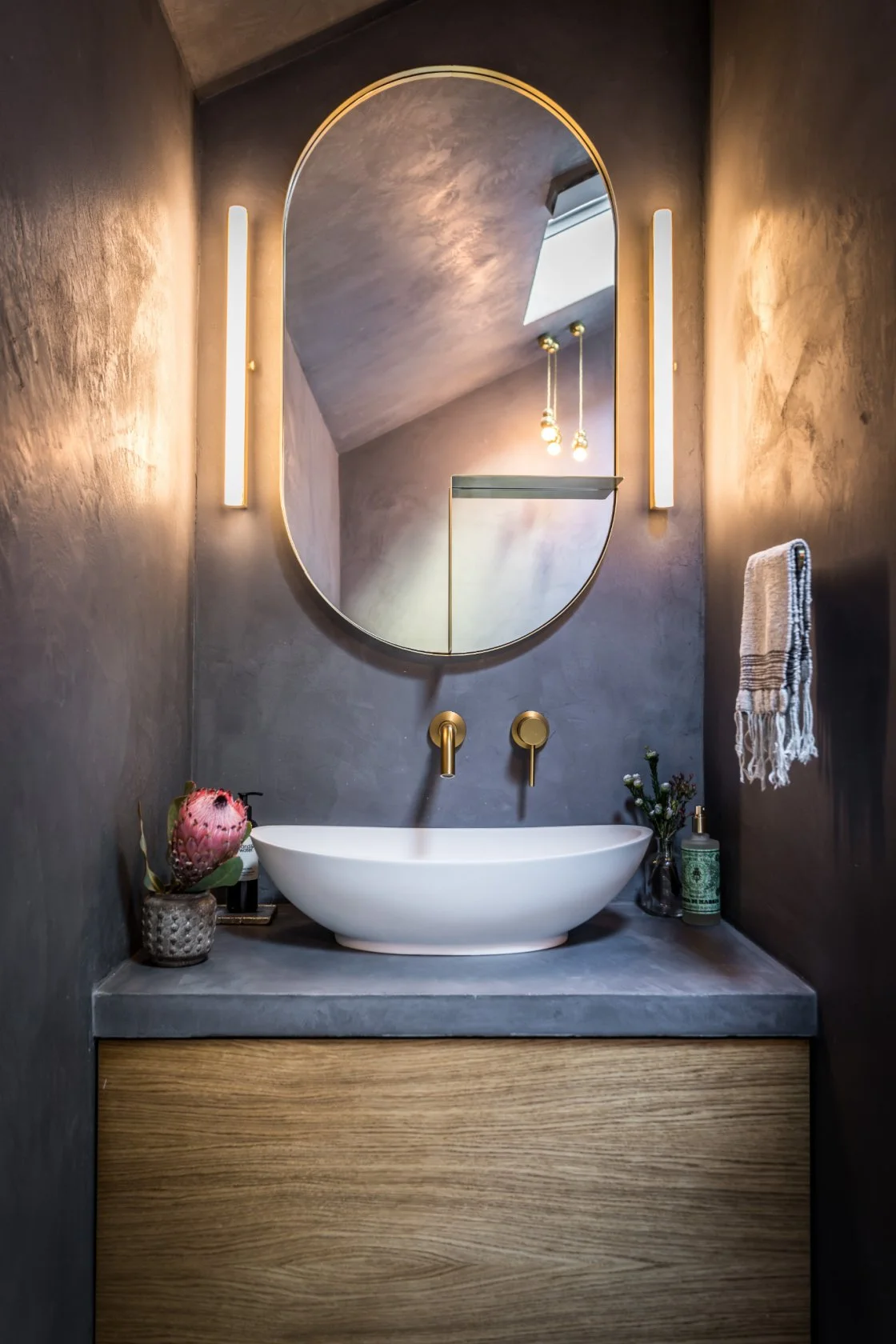
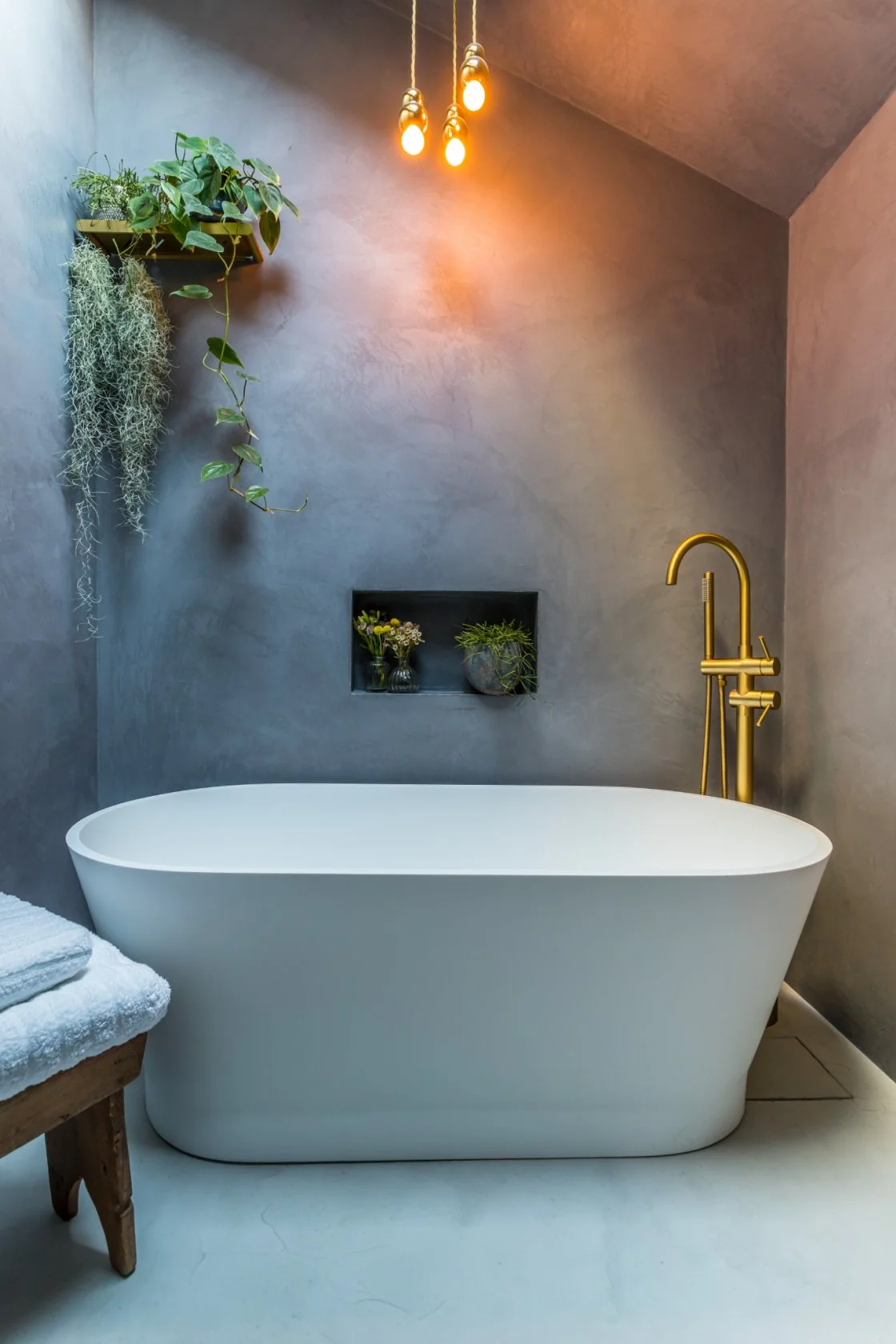
Bathroom Design: Creating Grout-Free Sanctuaries
The bathroom is where tadelakt and microcement move from interesting design choice to genuinely transformative decision, because eliminating grout lines does not just change how a space looks, it changes how it functions and feels every single day.
A common question that surfaces when homeowners first encounter these finishes is: how can a shower possibly work without tiles? The answer lies in the multi-layered waterproof membrane and the density of the finish. With tadelakt, the waterproofing is intrinsic: the lime reacts with black soap during burnishing to create a hydrophobic surface. With microcement, a dedicated waterproof primer and topcoat system provides the protection. Both approaches rely on continuity: no joints, no gaps, no grout for water to penetrate. As Lorraine notes, removing the grout also removes "the areas that tend to trap dirt and discolour in a traditionally tiled bathroom."
The shower
Seamless shower enclosures are the flagship application for both finishes, and the design possibilities they unlock are significant.
Integrate niches at the plastering stage, not as an afterthought: a recessed shelf formed in tadelakt or microcement becomes a sculptural element rather than a tile insert.
Specify anti-slip texture on the floor before application begins; a fine aggregate additive or a deliberately coarser trowel finish reduces slip risk without compromising the seamless aesthetic.
Use a single finish across walls, ceiling, and floor to maximise the sense of visual continuity.
Allow for movement joints at wall-to-floor junctions in larger showers, particularly with microcement, to manage substrate flex.
The floor
Wet-area floors demand extra attention to both safety and finish specification.
Confirm slip-resistance ratings with your applicator: a polished tadelakt floor suits a low-traffic wet room; microcement with a matt topcoat performs better underfoot in a busy family bathroom.
Keep colour mid-tone to dark in shower floors; very pale finishes show water marks and soap residue more readily.
Plan drainage placement early: linear drains align naturally with the directionality of a trowelled finish.
The vanity
Built-in vanity units and basin surrounds reward the same seamless thinking applied to the shower.
Wrap the basin surround in the same finish as the walls to create a monolithic effect that reads as high-end craftsmanship.
Pair warm-toned tadelakt with unlacquered brass for a material combination that ages gracefully together.
Use natural stone, such as honed marble or travertine, as a contrasting worktop surface; the texture difference adds tactile interest without breaking the calm palette.
Avoid polished chrome against a burnished tadelakt surface; the competing sheens can feel visually busy.
The next consideration, particularly relevant once you move beyond the bathroom, is how these finishes perform across floors in higher-traffic zones, from open-plan kitchens to hallways. That is where the durability question becomes critical.

Photo Credit: Interior design with Microcement floor in Victorian renovation project by Sophie Wells
Flooring and High-Traffic Zones: Where Strength Matters
When it comes to floors, the choice between tadelakt and microcement is not just aesthetic. It is structural, and getting it wrong is an expensive mistake.
Tadelakt's Achilles heel is underfoot load. Because it is a lime-based plaster finish, it lacks the compressive strength to handle sustained foot traffic, rolling chairs, or heavy furniture. In practice, tadelakt is typically reserved for walls, shower enclosures, and low-traffic decorative surfaces, not floors. This is a point Lorraine makes plainly from experience: "it is not recommended to use tadelakt on floors due to the durability of the product underfoot." Attempting to use it in a hallway or kitchen risks surface abrasion and, over time, visible degradation that compromises the finish's integrity.
Microcement, by contrast, is built for exactly this challenge. Its structural integrity allows it to withstand heavy furniture and commercial foot traffic without cracking, which is why you will find it specified for open-plan kitchen floors, retail showrooms, and hospitality interiors alike. A continuous microcement floor running from a living area through to a kitchen extension is one of the most practical uses of the material: seamless, hygienic, and genuinely robust.
Underfloor heating compatibility is another area where microcement performs well. Cementitious finishes conduct thermal energy efficiently, making them a sensible pairing with water-fed or electric underfloor heating systems. The key requirement is a stable, crack-free substrate: thermal cycling causes substrates to expand and contract, and any weakness in the base layer will eventually telegraph through to the surface finish.
Repairability is the honest caveat. Seamless floors carry an inherent challenge: if a localised area is damaged, such as a deep scratch or an impact chip, blending a repair invisibly into the existing cured surface is technically demanding. It requires the same applicator, the same batch of material, and considerable skill. This is one more reason why professional application matters, a point the next section explores in full, covering what the installation process actually involves from substrate preparation through to curing.

Photo Credit: Microcement floor in interior designer Sophie Wells’ own home
The Installation Process: What to Expect During Renovation
Both tadelakt and microcement reward patience, and penalise any attempt to shortcut the process. Understanding what happens on site helps you plan realistically and protect your investment from the outset.
Here is a typical installation journey, from bare substrate to sealed finish:
Substrate preparation. Everything starts with a stable, sound base. Any movement, moisture ingress, or surface contamination will telegraph through the final finish and become visible. For microcement especially, existing tiles or plasterwork must be assessed and, where necessary, removed or primed. Tadelakt demands a lime-compatible base, often requiring a fresh scratch coat before application begins.
First coat application. The applicator builds up the material in thin, controlled layers. This is not a paint-on process; each pass requires skill and consistency to avoid trapped air, uneven thickness, or visible joins.
Intermediate drying and sanding. Between coats, the surface must dry fully before any further work. Rushing this stage is where most failures begin. Ambient temperature, humidity, and ventilation all affect drying times, factors your installer should assess before starting.
Curing. This is the stage many homeowners underestimate. Tadelakt requires a specific carbonation period to reach full hardness and water resistance, a chemical process you simply cannot accelerate. Allow for several days minimum before the space is used.
Sealing and polishing. The final stage locks in durability and delivers the surface quality you have specified.
The reason substrate preparation sits at the top of that list is that it is where even experienced hands can be caught out. Lorraine is candid about a project where the layers beneath let a beautiful finish down:
"On this project I ran the underfloor heating up the wall behind a tadelakt finish instead of introducing a towel rail. Unfortunately, unbeknownst to me, the substrate had not been prepared correctly and, once the heating was switched on and the wall began to respond to the change in temperature, the surface cracked."
The damaged area had to be carefully repaired and refinished. Her takeaway is the single most important principle in specifying either material.
"It was a valuable reminder that finishes such as tadelakt and microcement are only ever as successful as the layers beneath them," Lorraine says. "These materials can look beautifully seamless, but they are not forgiving of shortcuts on site."
Designer tip: Resolve preparation, substrate movement and heating requirements before the decorative finish goes on, never after. A seamless surface will faithfully reproduce every weakness underneath it, so the money and time are best spent on the base.
On the dust question: microcement installation is notably cleaner than traditional tiling work, with no cutting, no adhesive, and no grout. Tadelakt generates minimal debris too, though wet plaster work requires careful masking of adjacent surfaces and fittings.
Professional application is not optional if you want a warranty. Both systems rely on precise product ratios, timing, and technique. An unqualified application typically voids manufacturer guarantees and leaves you with no recourse if the finish fails.
And once you understand the process, the next question becomes one of personalisation, because the finish itself offers far more creative range than most clients initially expect.
Bespoke Finishes: Customising Texture and Tone
Both tadelakt and microcement offer extraordinary creative range: your finish does not have to look like everyone else's bathroom or kitchen.
The starting point for most bespoke projects is pigmentation. Tadelakt achieves its palette through natural mineral oxide pigments blended into the lime, producing earthy, sun-bleached tones: warm ochres, chalky whites, dusty terracottas, and deep slate greys. Microcement takes a broader approach: bespoke microcement can be tinted to match any RAL or NCS colour, which means you can align the finish precisely with your wider interior design scheme, whether that is a muted Farrow & Ball-adjacent neutral or a bold industrial charcoal.
Texture is where these materials really diverge creatively. Microcement can be worked to a near-glass smoothness, almost resin-like under raking light, or deliberately opened up to reveal a pitted, raw concrete quality that reads more industrial and tactile. Tadelakt, by contrast, carries an inherent organic variation; the hand-polishing process creates gentle undulations and a luminous depth that no two applicators replicate identically. In practice, that means tadelakt suits spaces where warmth and handcrafted character are the goal, while microcement suits schemes demanding precision and repeatability.
For truly unique results, aggregates and metallic powders can be folded into microcement during mixing. Fine mica or bronze particles catch light differently across the day, shifting a wall from matte grey at noon to a warm, faintly lustrous surface by lamplight. It is a subtle effect, but one that adds genuine visual complexity without additional layering.
This sensitivity to light is one of the things clients least expect, and Lorraine flags it early in every project.
"Clients are often surprised by how much tadelakt and microcement change with the light," she says. "Neither is a completely flat or uniform finish: the colour can appear warmer, cooler, deeper or more mottled at different times of day. I always encourage clients to view large samples in the room itself, as a small swatch rarely conveys the movement and depth of the finished surface."
Designer tip: Never approve one of these finishes from a small swatch or a showroom board. Live with a large sample on the actual wall or floor, across a full day, so you see how it behaves in the room's own light before you commit.
One practical consideration worth raising early is that matching finishes across surfaces, say a bathroom wall carried through to a custom vanity unit, requires careful planning. The same mix batch, applicator, and curing conditions all affect the final tone. Getting this right is one area where working with an experienced specialist really pays off, and it is something Decorbuddi's design consultants factor in from the very first project conversation.
Beyond aesthetics, these material choices carry environmental implications too, and that is worth exploring as you finalise your specification.
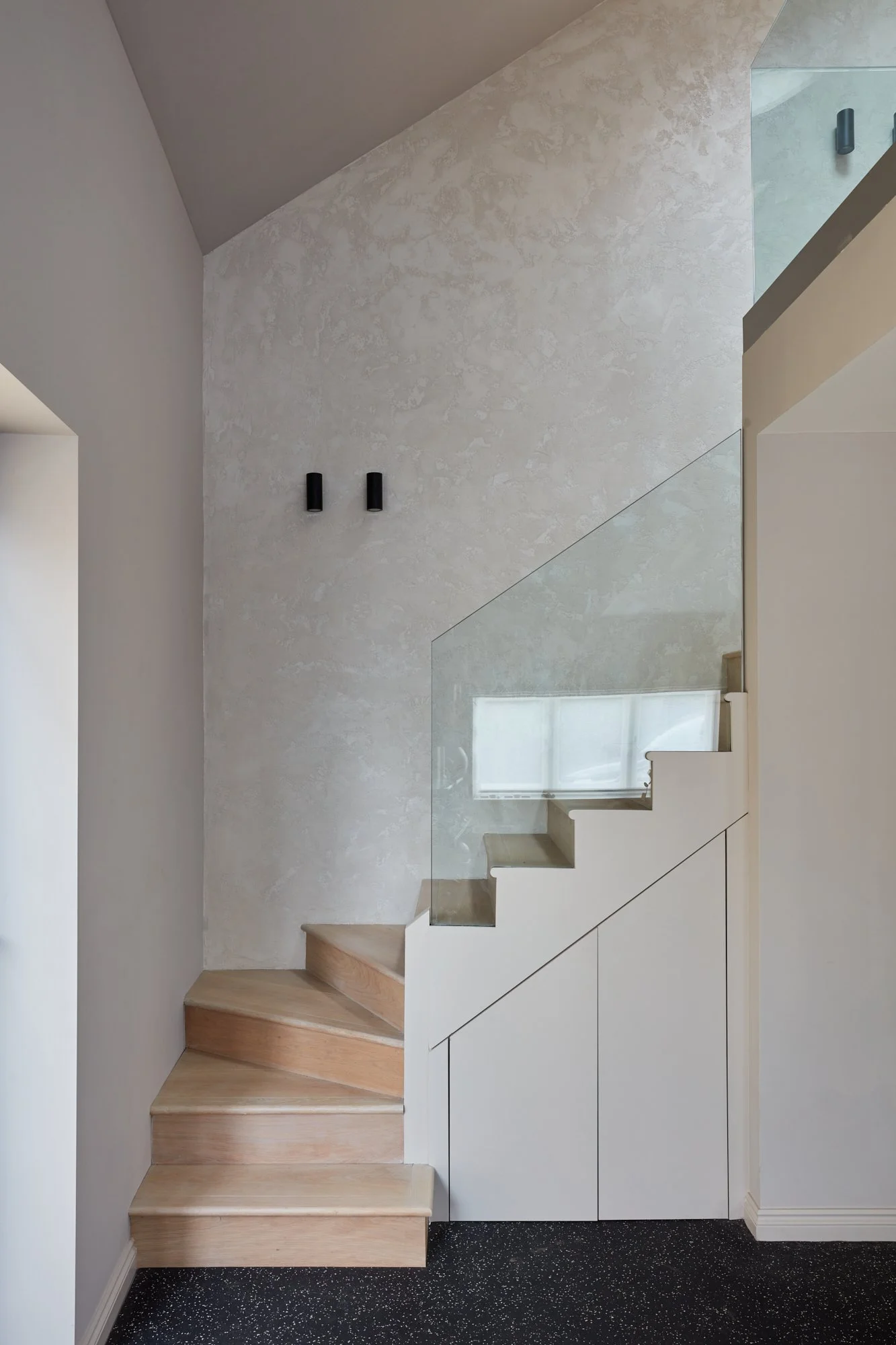
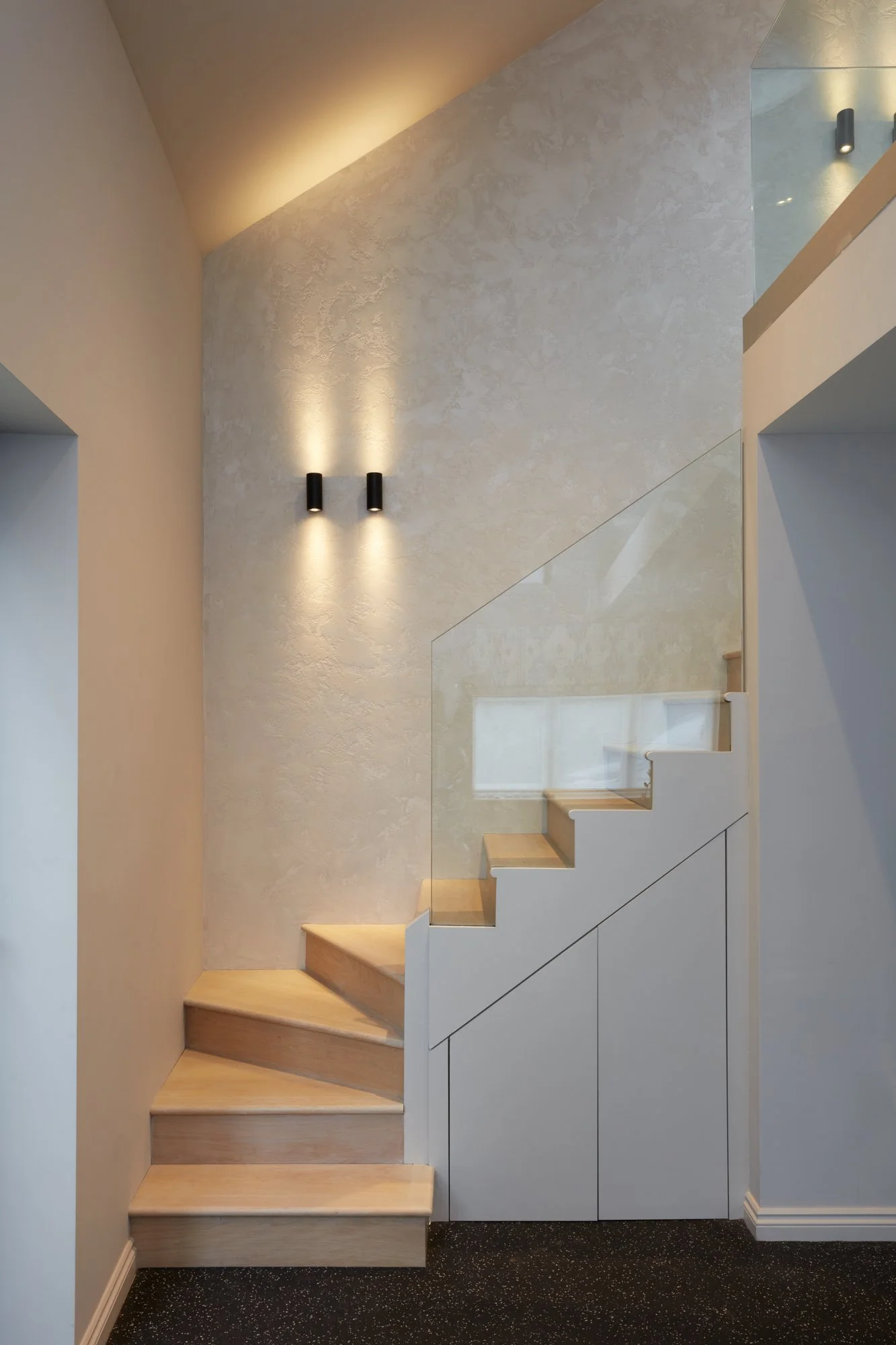
Photo Credit: Venetian plaster walls from our Wimbledon interior design project by Helene Dabrowski
Sustainability and Health: The Eco-Credentials of Seamless Finishes
Choosing tadelakt or microcement is not just an aesthetic decision. It is an environmental one, and the differences between the two materials matter more than most guides acknowledge.
VOC levels are often the first health concern homeowners raise. Traditional lime-based tadelakt is a natural mineral material, free from volatile organic compounds in its base form. Microcement, by contrast, relies on polymer resins as binding agents, and the quality of those resins varies considerably between product ranges. Lower-grade formulations can let off-gas during and after application, affecting indoor air quality, which is particularly relevant in bathrooms and kitchens where ventilation is often limited.
Eco-fact: Lime-based tadelakt absorbs CO₂ during its curing process through a natural carbonation reaction, partially offsetting its production footprint, a genuine ecological advantage that synthetic alternatives cannot replicate.
Longevity is arguably the most underrated sustainability credential of both finishes. A well-maintained seamless surface can last decades, eliminating the waste generated by retiling cycles every ten to fifteen years. Grout degrades, tiles crack, and adhesives fail, each replacement sending hundreds of kilograms of ceramic and cement waste to landfill. Tadelakt and microcement sidestep that cycle entirely when correctly installed and sealed.
Thermal mass is another practical benefit worth understanding. Lime plaster and cementitious coatings applied to masonry walls contribute to the thermal mass of a room, helping it retain heat in winter and stay cooler in summer. In an energy-efficient home, particularly one designed around passive principles, this characteristic supports a reduced heating load over time.
Eco-fact: Cement manufacturing accounts for roughly 8% of global CO₂ emissions, but lime production, while energy-intensive, operates at lower kiln temperatures and produces a material that continues to sequester carbon long after application.
The environmental case for both finishes is genuine, though nuanced. Tadelakt holds a clear advantage on embodied carbon and indoor air quality. Microcement offers durability and minimal waste generation in its own right. Choosing between them wisely, with the right specification for your space, is where expert guidance makes a measurable difference.


Photo Credit: Microcement bathroom design in Victorian renovation project by Sophie Wells
Living With These Finishes
One of the most important expectations to set early is that these are living, hand-applied surfaces, not porcelain. Clients who understand that from the outset tend to love the result; those expecting the flat uniformity of a factory-made tile can be caught off guard.
The finishes evolve. Tadelakt becomes richer and more characterful as it ages, while microcement may gradually show the subtle marks of everyday life. As Lorraine sees it, that is part of the appeal rather than a drawback.
"What clients often come to appreciate is that these are living, hand-applied surfaces," she says. "They soften a room and develop character over time rather than remaining pristine and unchanged."
Set against that gentle patina are two genuine practical wins. The continuous surface creates a calmer, more seamless appearance and removes the grout lines that trap dirt and discolour in a traditionally tiled bathroom. And day-to-day upkeep is straightforward: microcement floors can be swept and wiped rather than scrubbed between tiles, and tadelakt needs only a gentler, non-abrasive cleaning routine to keep its integrity. Managed with realistic expectations, both finishes reward the homeowner for years.

Expert Design Consultation: Navigating Your Renovation with Decorbuddi
Choosing tadelakt or microcement is only half the decision. Getting the specification, sequencing, and specialist right determines whether the finished result matches your vision.
Both materials demand skilled hands, precise conditions, and careful coordination with other trades. A tadelakt bathroom, for instance, requires the plasterer to work before final plumbing fixtures are fitted, while microcement floor applications need substrate preparation that must be factored into the broader build programme. Without a designer managing these dependencies, costly mistakes, such as a cracked substrate, an improperly sealed surface, or a tone mismatch, become far more likely.
Decorbuddi's approach is to assemble the right combination of skills for each project. A team of more than 20 designers, supported by a trusted network of specialist makers, suppliers and trades, means the person specifying and applying your finish has demonstrable experience with that specific material in comparable conditions. This is joined-up expertise that extends well beyond a single design perspective, not a general contractor arrangement.
The 'Get Started' consultation is where this process begins in practice. It is an opportunity to review your space, substrate, moisture exposure, and aesthetic goals before any material is specified, preventing the most common and expensive errors homeowners make when selecting seamless finishes without specialist input.
Ready to specify your project with confidence? Book a Get Started consultation with Decorbuddi to match your tadelakt or microcement vision with the right specialist from day one.